

Iconic engines. Mechanical Masterpieces. Works of art, born to please the senses. But what are those determining factors that make an automobile engine iconic?
Let’s take the example of time as a determining factor. “How?”, you ask? Let’s talk about a powerplant that has been built for nearly 50 years, being upgraded bit by bit over the passage of time. Yes. Half a century! If an iconic automaker sticks with the same engine for nearly 50 years, despite having the financial means to develop a new engine, it must be one marvel of an engineering feat.
Let me introduce to you, The Bizzarini V12. This engine was used in every single production V12 Lamborghini from 1964, with the 350 GT, Lamborghini’s first ever production automobile, all the way to my dream car, the flamboyant Lamborghini Murciélago till 2010.
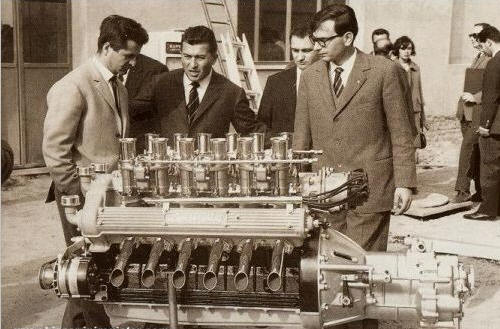
Here’s a historical photograph of Giotto Bizzarini, Ferruccio Lamborghini, and Gian Paolo Dallara with the original prototype of the V12. Giotto Bizzarini, by then, a renowned auto engineer was comissioned by Ferruccio Lamborghini to design an engine for his “perfect” Gran Turismo. A car he would build as a response to the insulting remarks of Enzo Ferrari.
The engine started out as a quad cam (DOHC) V12, displacing 3.5 litres with 2 valves per cylinder. It was a normally aspirated Formula 1 inspired design that Bizzarini intended to rev all the way to 11,000 RPM, producing 400 horsepower. The road-going de-tuned variant with 6 Weber Carburetors would go on to produce 280 horsepower. An understressed, yet objectively powerful engine is essential for a true GT.
But let’s get back to the main subject of discussion. The Murciélago engine. It came in 2 iterations. A 6.2 and a 6.5. Produced from 2001 to 2006, the 6.2 was a perfect blend of the mechanical clicks, vibrations and roars of the past with the emotional scream of the future. Produced from 2006 to 2010, the 6.5 was probably one of the closest, a production road-going supercar has ever come to sounding like a true Formula 1 machine.
The LP 640-4, as it was called, could churn out 632 horsepower (640 PS), propelling the Murcie from 0-62 in a blistering 3.1 seconds and onto a top speed of 340 Km/h.
Then came the LP 670-4 Super Veloce, or the SV. A stripped down, bare bones, rough and tough version of a car, once considered to be “too soft” for a Lamborghini. While the dynamics and achieved figures say otherwise, the Murciélago really was one of the first Lambos to feature a ride and amenities that could technically make it useable everyday.
Let’s talk nomenclature. The LP stands for, ‘Longitudinale Posteriore’. It denotes that the V12 engine is mounted longitudinally to the chassis. The 640 and 670 refers to the power in PS, not horsepower. The 4 stands for 4 wheel drive. Yes, they had 4 wheel drive, but the system was geared for ensuring you have the most fun without spinning out of control. It was truly an enthusiast’s system.
Equipped with the famous gated 6-speed manual or the optional E-Gear single clutch semi automatic with paddle shifters, the engine can truly deliver, revving all the way to 8000 RPM. Usually one could expect an engine of such sheer, massive proportions to be under stressed, lazy and torquey. But here, it certainly is torquey with the Super Veloce producing 660 NMs of it. But all the torque came at very high revs, accompanied by a sound fit for automotive heaven. Take a listen.
But what makes the Bizzarini V12 truly special is its surprising durability. Sure, in the older cars, they used to occasionally go wrong, but they were almost always an upgrade that could solve the problem. Even the serious issues like potential fire were caused by minor things which could be fixed to be prevented. In the Murciélago, the E-Gear transmission was a violent shifter and used to eat clutches like we breathe oxygen, but get the manual and there’s no issue. An enthusiast’s favourite and also only increases in value over time.
But on the flipside, the E-Gear was known to be extremely fun. That violent shift that happens inbetween the pause were the engine goes suddenly silent, and after which, roars back to the speed it was doing, while you get pulled forward and violently thrown back again, is just what the doctor ordered.
There are a few cases of the Murciélago hitting the 200,000 mile mark and even crossing it well over. Says a lot.
Lamborghinis come with massive fuel tanks for a reason. The Murciélago had a staggering 100 litre fuel tank. So it actually allows for a reasonable range. Although the highlight here is not practicality, but pure, unadulterated emotions.
It has been over a decade since this amazing engine has been retired after nearly half a century of service. But it shall never be forgotten. And with a symphony like that, who can?
It’s a dream. And life is all about having a dream that one pursues and achieves victory over. That is when one can say, “I have lived.”
– Abhyjith. K. Ashokan
“Keep The Passion Strong!”
Don’t Miss Out On The Fun:
Instagram: https://www.instagram.com/flamboyance_gt_102/
Pinterest : www.pinterest.com/flamboyancegt
Twitter : https://twitter.com/flamboyancegt12
Tumblr : https://flamboyancegt-blog.tumblr.com/
For more fascinating automotive content, press the subscribe button to get notified of my writings as soon as they’re up!
For suggestions as well as constructive criticism, feel free to leave a comment below or shoot me an email at flamboyancegt@gmail.comThank you for visiting and have a wonderful day!
 Flamboyance GT