
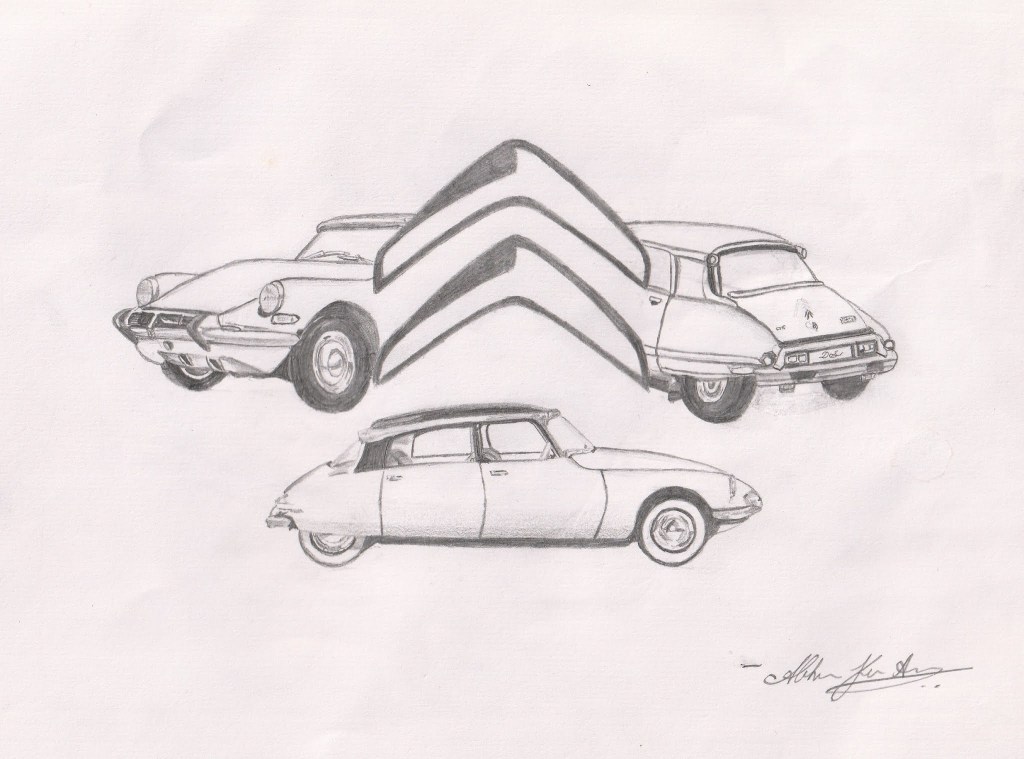
‘DS’ isn’t really an abbreviation of any sort. It actually is a pun for the French word, ‘Déesse.’ Do you know what that means? Goddess! When a car is given such a name, that on its own is enough to create rather large shoes to fill, let alone those of a predecessor. And a proper predecessor at that. The Citroën Traction Avant. For reference, that car was once called, “Reine de la route”, or as can be said in English, “Queen of the road.”
When the DS was unveiled on the 5th of October, 1955 at the Paris Motor Show, it had undergone 18 years of development! The DS also had another responsibility. It was one of the earlier new luxury cars to come out after World War II in France. Automobiles have traditionally and historically been symbols. Symbols, representing multiple aspects. Status, innovation, daring, breaking boundaries, etc, etc, etc just to name a few. So the new Citroën had to be one that showed that France was on the road to recovery, in the literal sense, and getting back to producing ingenious, eccentric, and absolutely unique products like it always had.
That’s the beauty of French cars. They are unusual, but in such a refreshing way. It is the same concept as surrealism. Its an external expression of whatever is odd and atypical, within. Its a release. It feels liberating. Certain French cars capture this beautifully. Like the DS! And how can it not? After all the Art Nouveau movement found great acceptance and popularity in Paris!
For instance, look at the steering wheel of a DS. I personally feel the steering design in any automobile is an extremely important aspect. Why? Its for the simple, logical reason that the steering is what we face while we drive! That’s the last place where one should want an eyesore. The steering wheel of a DS is a single spoke design! Now where else have you seen such an oddity?
Then we move on to the exterior. The front of the pre facelifted version is so beautiful and soulful. That’s the one in my drawing. I can certainly see links with the likes of the Jaguar E type, the Porsche 911 and the Alfa Romeo Spider. After all, birds of the same feather flock together! Mind you, the DS came much before all of them. When it came, many called the DS, the most beautiful car in the world!
It really was a sensation when it was revealed. A body with beautiful curves and lines that met towards the rear like they melted and blended as it glided past your eyes. And it really did glide. The moniker, ‘Magic Carpet ride’ didn’t come by for no reason. All was thanks to the ingenious hydro-pneumatic self levelling suspension. It was a proper technological innovation for its time.
This system was also capable of lifting and lowering the car as per the wish of the owner, by the flick of a switch, to clear undulations and alter its driving dynamics.
Speaking of which, the system allowed the car to be capable of transporting its passengers in the pinnacle of ride comfort while also providing sharp handling and the ability to effortlessly corner. This made it more than ideal for rallying, allowing it to take the trophy over at Monte Carlo in 1959 and 1966, the 1000 Lakes Rally of 1962 in Finland, and others.
During the 10 days of the 1955 Paris Motor Show, the DS received a world record of 80,000 deposits, which it held for 60 years, being surpassed by the Tesla Model 3 in 2016. The number on the first day was 12,000 and for the first 15 minutes was apparently 743!
The Citroën DS was the first mass produced car featuring disc brakes. The key word is “Mass produced.” Disc brakes were invented and used by the British company, Lanchester in the 1890s and 1900s.
The Citroën DS used hydraulics in more than just the suspension. The brakes were hydraulic, so was the power steering, so was the clutch. Speaking of which, there were 3 transmission types on option. A 4 and a 5 speed manual, a 3 speed automatic and a 4 speed semi-automatic, also known as ‘Hydraulique’ or ‘Citromatic.’ Now this specific one is mighty interesting. It didn’t have a clutch pedal. It had a column mounted shifting lever which the driver had to flick to the desired gear position, while easing on the throttle, and the car would use its hydraulic systems to shift the gears!
1,455,746 examples were produced in total worldwide, of which, 1,330,755 were produced at the Quai André-Citroën factory in Paris. The other production facilities were located at Slough in England, Heidelberg, Victoria in Australia, Koper in present day Slovenia (Former Yugoslavia), Johannesburg in South Africa, and Mangualde in Portugal.
The car came with a 4 cylinder engine, in 4 different capacities. a 1,911, a 1,985, a 2,175, and a 2,347cc. This was all initially influenced by a certain French tax on cars which encouraged the use of smaller and more efficient engines. You can find more about that here. The car required constant engine updates due to being a tad bit underpowered, especially with the early ones. A shortcoming that was eventually fixed.
In 1967, it received a facelift wherein those lovely headlights I mentioned were replaced with a new style that is famously described as making the car look shark-like. Now, I like it in the sense that variety and uniqueness is something we require in the field of art and design. This new design also incorporated the famous directional lights where the lights swivel in the direction the steering wheel is turned to aid in visibility. I think this is really interesting. It would feel like the car is showing the way ahead and leading you towards it.
Apart from that, they could be had as a stylish 4 door sedan, an stunningly exotic looking convertible, and as a practical, yet classy station wagon. Tasteful variations for all purposes!
The estate version was apparently used as a camera car for filming, especially by the BBC because the wonderful ride made filming convenient without shakes! It was also used as an ambulance for the same reasons, I suppose.
On the 22nd of August, 1962, at Le Petit-Clamart near Paris, an assassination attempt took place against President Charles De Gaulle. He was travelling with his wife in his un-armored Citroën DS. A violent ambush ensued. Machine guns were fired, riddling the car with bullets and puncturing all 4 tyres. Yet, the car kept them both safe from harm and managed to pull away and escape at full speed. The President vowed never to ride in any other make of car again.
Let us get back to a point I made at the beginning. The Citroën DS had really large shoes to fill when it was launched. Has it accomplished this? Well, with such historical and technical credentials, how can it not? In fact, it demands a size larger!
And with such a beautiful design language that speaks directly to the heart, how can one not fall for it? It sure is one of the all time greats!
– Abhyjith. K. Ashokan
Also check out this wonderful article by Petrolicious about the story of a lovely 1974 Citroen DS and her owner. You can find it here!
Don’t Miss Out On The Fun:
Instagram: https://www.instagram.com/flamboyance_gt_102/
Pinterest : www.pinterest.com/flamboyancegt
Twitter : https://twitter.com/flamboyancegt12
Tumblr : https://flamboyancegt-blog.tumblr.com/
For suggestions as well as constructive criticism, feel free to leave a comment below or shoot me an email at flamboyancegt@gmail.com
 Flamboyance GT